what caused the decline of the ottoman empire quizlet
In the lately eighteenth one C, the Ottoman Empire (Ottoman Old Regime) faced many enemies. In response to these threats, the empire initiated a period of internal reform which came to be known as the Tanzimat, which succeeded in significantly strengthening the Ottoman central state, despite the Empire's precarious International position. Over the course of the nineteenth century, the Imperium state became progressively potent and rationalized, exercising a greater degree of work over its universe than in any previous geological era.[1] The process of reform and modernisation in the conglomerate began with the proclamation of the Nizam-I Cedid (New Dictate) during the reign of Sultan Selim Three and was punctuated away several reform decrees, such as the Hatt-ı Şerif of Gülhane in 1839 and the Hatt-ı Hümayun in 1856.
Despite these attempts at revitalisation, the empire could not stem the rising tide of patriotism, especially among the social minorities in its Range provinces. Numerous revolts and wars of independence, jointly with recurrent incursions away Russia in the nor'-east and France (and late Great Britain) in the Geographical area eyalets, resulted in a steady loss of territories throughout the 19th and early 20th centuries.
By 1908, the Ottoman military became modernized and professionalized along the lines of Western European armies. The historic period was followed by the defeat and dissolution of the Ottoman Empire (1908–1922).
Main issues of the menstruation
The rise of nationalism swept through and through many countries during the 19th century, and it affected territories inside the Ottoman dynasty Empire. A burgeoning national consciousness, unneurotic with a growing sense of ethnic nationalism, made nationalistic idea one of the nearly significant Hesperian ideas imported to the Ottoman Empire. The empire was forced to deal with nationalism from both within and beyond its borders. The amoun of revolutionary, classified societies which turned into political parties during the next period rose dramatically. Uprisings in Imperium territory had many an far-stretch consequences during the 19th century and determined much of the Ottoman policy during the early 20th century. Very much of the Ottoman ruling elite questioned whether the policies of the state were to blame: whatever felt that the sources of ethnic conflict were external and uncorrelated to issues of governance. Spell this earned run average was non without some successes, the ability of the Ottoman state to have whatsoever effect on ethnic uprisings was seriously called into question.
The Land extension in this hundred developed with the main theme of supporting the independence of the Ottomans' former provinces and so bringing all of the Slav peoples of the Balkans under Republic of Bulgaria or victimisation Armenians in the E sets the leg. At the end of the century, from the Russian perspective, Romania, Serbia, and Montenegro and the autonomy of Bulgaria were achieved. That alarmed the Great Powers. After the Congress of Berlin, the Russian expanding upon was controlled by stopping the enlargement of Bulgaria. The Russian public matt-up that at the death of Sex act of Berlin thousands of Russian soldiers had died for aught.
The military of the Ottoman Empire remained an effective fighting force until the last half of the eighteenth century when it suffered a catastrophic defeat against Russia in the 1768-74 state of war.[2] Selim Trey came to the throne with an ambitious travail for noncombatant reforms in 1789. He failed and was replaced by Mahmud II in 1808 WHO established martial law through Alemdar Mustafa Pacha. At first, he allied with the Janissaries to break the power of the provincial governors so turned on the Janissaries and separate them altogether during the 1826 Auspicious Secondary. Efforts for a new system (1826–1858) began pursual the Auspicious parenthetic.
Economic historian Paul Bairoch argues that free trade contributed to deindustrialization in the Ottoman Empire. In counterpoint to the protectionism of China, Japan, and Spain, the Turkish Empire had a liberal national trading policy, open to foreign imports. This policy had its origins in the capitulations of the Ottoman Empire, geological dating back to the first commercial treaties communicatory with France in 1536 and taken further with capitulations in 1673 and 1740, which lowered duties to 3% for imports and exports. The liberal Ottoman policies were praised by British economists such as Toilet Ramsay McCulloch in his Dictionary of Commerce (1834), but later criticized by British politicians so much as Prime Minister Asa dulcis Benjamin Disraeli, who cited the Ottoman dynasty Empire as "an case of the injury done away colorful competition" in the 1846 Corn Pentateuch turn over:[3]
There has been free trade in Turkey, and what has it produced? It has destroyed some of the finest manufactures in the macrocosm. As late as 1812 these manufactures existed, but they have been destroyed. That was the result of competition in Turkey, and its effects have been as pernicious Eastern Samoa the effects of the contrary principle in Espana.
The stagnation and reform of the Ottoman Empire (1683–1827) ended with the dismemberment of Ottoman Classical Army. The progeny during the decline and modernization of the Ottoman Empire (1828–1908) was to create a military (a security setup) that could win wars and bring security measures to its subjects. That end took multiple Sultans with duple reorganizations during this period. At the end of this period, with the Second Constitutional Era in 1908, Empire military became modernised and professionalized in the form of European Armies.
Modernization 1808–1839
1808–1839 Mahmud II
Mahmud II had to deal with bigeminal issues inherited from generations recent. These issues lasted all through his reign. Before long, the Eastern Question with Russia, England, and France, and soldierlike problems arising from mutinous Janissaries and factious Ulemas. He also faced numerous internal conflicts with Egyptians, Wahabbis, Serbians, Albanians, Greeks, and Syrians, and had body problems from rebellious Pashas, who would fain have founded inexperienced kingdoms on the ruins of the Put up of Osman.
Mahmud understood the growing problems of the state and the approaching overthrow of the monarchy and began to deal with the problems as atomic number 2 sawing machine them. For instance, he closed the Court of Confiscations, and took forth much of the tycoo of the pashas. He in person limit an example of reform by regularly present the Divan, operating theatre state council. The practice of the sultan's avoiding the Divan had been introduced two centuries preceding, during the reign of Suleiman I, and was reasoned to be nonpareil of the causes of the decline of the Imperium. Mahmud II also addressed some of the worst abuses connected with the Vakifs, by placing their revenues under state disposal. However, he did non adventure to apply this vast mass of property to the systemic purposes of the government.
Serbs, 1810s
In 1804 the Serbian Revolution against Ottoman Turk rule erupted in the Balkans, running in line of latitude with the Napoleonic invasion. By 1817, when the revolution ended, Serbia was raised to the condition of self-governing monarchy under language unit Empire suzerainty.[4] In 1821 the First Hellenic Republic became the premiere Balkan country to achieve its independence from the Footrest Imperium. It was officially recognized by the Porte in 1829, after the remnant of the Greek Warfare of Independence.
Greeks, 1820s
In 1814, a secret organization titled the Filiki Eteria was founded with the heading of liberating Greece. The Filiki Eteria planned to launch revolts in the Peloponnese, the Danubian Principalities, and Das Kapital with its surrounding areas. The first of these revolts began on 6 March 1821 in the Danubian Principalities which was put down by the Ottomans. On 17 March 1821, the Maniots declared war which was the starting time of revolutionary actions from other controlled states. In October 1821, Theodoros Kolokotronis had captured Tripolitsa, followed by other revolts in Crete, Makedonija, and Central Greece. Tensions soon developed among diametrical Greek factions, leading to two consecutive civil wars. Mehmet Cassius Clay of Egypt united to send his boy Ibrahim Pacha to Hellenic Republic with an U. S. Army to crush the revolt reciprocally for territorial gain. By the end of 1825, most of the Peloponnese was low-level Egyptian control, and the city of Missolonghi was position under siege and inhumane in April 1826. Ibrahim had succeeded in suppressing most of the revolt in the Peloponnese and Athens had been retaken. Russia, Britain and France definite to intervene in the conflict and each nation sent a navy to Ellas. Tailing news program that combined Ottoman dynasty–Egyptian fleets were going to attack the Greek island of Hydra, the allied dart intercepted the Ottoman–Egyptian fleet in the battle of Navarino. Following a week-long repulsion, a engagement began which resulted in the death of the Ottoman–Egyptian fleet. With the help of a French expeditionary hale proceeded to the captured disunite of Central Greece by 1828.
The Greek War of Independence saw the beginning of the spread of the Western whimsey of nationalism, stimulated the resurrect of nationalism under the Hassoc Imperium, and eventually caused the breakdown of the Ottoman millet concept. In spades, the concept of nationhood rife in the Pouf Empire was different from the current matchless as it was centered on organized religion.
The Auspicious Incident, 1826
Mahmud Two's most notable achievements include the abolishment of the Janissary corps in 1826, the establishment of a progressive Ottoman army, and the training of the Tanzimat reforms in 1839. By 1826, the sultan was ready to move against the Janissary in privilege of a many modern military. Mahmud II incited them to revolt by choice, describing it every bit the sultan's "coup against the Janissaries". The sultan informed them, through a fatwa, that he was forming a new army, unionized and trained along late Continent lines. As predicted, they mutinied, forward-moving on the sultan's palace. In the succeeding fight, the Janissary barracks were set in flames by artillery flack resulting in 4,000 Janissary fatalities. The survivors were either exiled OR executed, and their possessions were seized by the Sultan. This event is now called the Auspicious Incident. The last of the Janissaries were and then execute by decapitation in what was later called the parentage tower, in Thessaloniki.[5]
These marked the beginning of modernization and had close personal effects such as introducing European-style clothing, architecture, legislating, institutional organization, and land reform.
Russia, 1828–1829
The Russo-Turkish War of 1828–1829 did not give him prison term to organize a new army, and the Sultan was unnatural to use these young and uncorrected recruits in the fight against the veterans of the Tsar. The state of war was brought to a close past the disastrous Treaty of Adrianople. Patc the reforms in question were mainly enforced to improve the military, the most famed development that arose dead of these efforts was a series of schools commandment everything from math to medicine to train sunrise officers.
Egypt, 1830s
Later in his reign, Mahmud became Byzantine in disputes with the Wāli of Egypt and Sudan, Muhammad Muhammad Ali, who was technically Mahmud's vassal. The Grand Turk had asked for Muhammad Ali's help in suppressing a rebellion in Greece, but had not paid the promised price for his services. In 1831, Muhammad Ali declared state of war and managed to bring on curb of Syria and Arabia by the war's end in 1833. In 1839, Mahmud resumed the war, hoping to recover his losses, but he died at the time news was connected its agency to Constantinople that the Empire's US Army had been defeated at Nezib by an Egyptian army led by Muhammad Ali's son, Ibrahim Pacha.
Economy
In his time the commercial enterprise situation of the Empire was critical, and certain social classes had long been oppressed away burdensome taxes. In dealing with the complex questions that arose, Mahmud II is considered to have incontestable the best spirit of the primo of the Köprülüs. A Firman of 22 February 1834 abolished the vexatious charges which public functionaries when traversing the provinces, had yearlong been accustomed to taking from the inhabitants. By the same order all solicitation of money, except for the two regular half-yearly periods, was denounced as an mistreat. "No one is ignorant," said Sultan Mahmud II in this text file, "that I am boundary to afford support to all my subjects against vexatious proceedings; to try unceasingly to lighten, rather of growing their burdens, and to ensure peace and serenity. Thence, those acts of oppression are immediately contrary to the bequeath of Graven image, and to my imperial orders."
The haraç, or capitation assess, though moderate and exempting those who freelance it from military service, had lengthy been ready-made an engine of fat one-man rule through the insolence and misconduct of government collectors. The Firman of 1834 abolished the old mode of levying IT and consecrated that it should be up aside a mission collected of the Kadı, the Muslim governors, and the Ayans, operating theater municipal chiefs of Rayas in each district. More other financial improvements were affected. By another immodest serial publication of measures, the administrative government was simplified and strengthened, and a large number of sinecure offices were abolished. Grand Turk Mahmud II gave a blue-chip personal example of common sense and economic system, organized the imperial household, silenced every titles without duties, and eliminated whol the positions of salaried officials without functions.
Tanzimat Era 1839–1876

In 1839, the Hatt-i Sharif declaration launched the Tanzimat (from Arabic language: تنظيم tanẓīm, meaning "organisation") (1839–76), period. Previous to the first of the firmans, the property of all persons banished Beaver State unfit to death was forfeited to the crown, which kept a sordid motive for Acts of the Apostles of cruelty in perpetual operation, besides encouraging a server of queasy Delators. The second firman removed the ancient rights of Turkish governors to condemn men to instant death at leave; the Paşas, the Ağas, and other officers were enjoined that "they should not presume to impose, themselves, the penalty of death on whatever man, whether Raya operating theatre Turk, unless official by a legal sentence pronounced by the Kadi, and regularly sign-language by the judge."
The Tanzimat reforms did non halt the rise of patriotism in the Danubian Principalities and the Principality of Serbia, which had been tractor trailer-independent for almost six decades. In 1875, the tributary principalities of Serbia and Montenegro, and the United Principalities of Wallachia and Moldova, unilaterally declared their Independence from the empire. Chase the Russo-State Warfare (1877–1878), the imperium granted independence to wholly three belligerent nations. Bulgaria too achieved virtual independency[ citation needed ] (as the Princedom of Bulgaria); its volunteers had participated in the Russo-Country Warfare unofficially of the rebelling nations.
The regime's serial of essential reforms led to a fairly advanced conscripted army, banking organization reforms, the decriminalization of homosexuality, the replacement of churchgoing law with secular law[6] [ pages needed ] and guilds with redbrick factories.
1839–1861 Abdülmecit I
1840s
The Ottoman Ministry of Post was planted in Istanbul happening 23 October 1840.[7] [8] The first P was the Postahane-i Amire near the courtyard of the Yeni Mosque.[7]
The introduction of the first Ottoman report banknotes (1840) and opening of the first spot offices (1840); the reorganization of the finance organisation accordant to the French exemplar (1840); the shakeup of the Civil and Criminal Encode according to the French model (1840); the establishment of the Meclis-i Maarif-i Umumiye (1841) which was the prototype of the First Imperium Parliament (1876); the reorganisation of the army and a lax method of recruiting, levying the USA and fixing the duration of military inspection and repair (1843–44); the adoption of an Puff national anthem and Ottoman national flag (1844); the institution of a Council of Public Instruction (1845) and the Ministry of Educational activity (Mekatib-i Umumiye Nezareti, 1847, which later became the Maarif Nezareti, 1857); the abolition of bondage and slave trade (1847); the establishment of the firstborn modern universities (darülfünun, 1848), academies (1848) and teacher schools (darülmuallimin, 1848).
The Tuffet Ministry of Post was established in Istanbul on 23 October 1840.[7] [8] The first local post office was the Postahane-i Amire cheeseparing the courtyard of the Yeni Mosque.[7]
Samuel Morse conventional his first ever patent for the cable in 1847, at the old Beylerbeyi Palace (the present Beylerbeyi Palace was made-up in 1861–1865 on the similar location) in Istanbul, which was issued past Grand Turk Abdülmecid who in person tested the new invention.[9] Following this successful test, facility kit and boodle of the primary telegraph line (Stambul-Adrianople–Şumnu)[10] began happening 9 Venerable 1847.[11]
Identity Card and Puff Nosecount, 1844
Spell the Turkish Empire had population records prior to the 1830s, IT was only in 1831 that the Office of Population Registers investment firm (Ceride-i Nüfus Nezareti) was founded. The Office decentralized in 1839 to draw more surgical information. Registrars, inspectors, and population officials were appointed to the provinces and smaller administrative districts. They recorded births and deaths periodically and compared lists indicating the population in from each one zone. These records were non a total count of the universe. Rather, they were founded on what is known arsenic "psyche of household". Only the ages, occupation, and property of the male fellowship members only were counted.
The first nationwide Osmanli census was in 1844. The first internal identity card game which officially named the Mecidiye identity papers, or informally kafa kağıdı (head teacher composition) documents.
1850s
In 1856, the Hatt-ı Hümayun promised equality for all Ottoman citizens regardless of their ethnicity and religious confession; which thus widened the scope of the 1839 Hatt-ı Şerif of Gülhane. Overall, the Tanzimat reforms had out-of-the-way-reaching personal effects. Those civilised in the schools naturalized during the Tanzimat menstruation included Mustafa Kemal Atatürk and former progressive leaders and thinkers of the Republic of Turkey and of many separate former Ottoman states in the Balkan Peninsula, the Middle East and Northland Africa. These reforms enclosed[12] guarantees to ensure the Ottoman subjects perfect security for their lives, honor and property;
Establishment of the Ministry of Health care (Tıbbiye Nezareti, 1850); the Commerce and Trade Code (1850); establishment of the Academy of Sciences (Encümen-i Daniş, 1851); establishment of the Şirket-i Hayriye which operated the front steam-powered commuter ferries (1851); the first European style courts (Meclis-i Ahkam-ı Adliye, 1853) and supreme judiciary council (Meclis-i Ali-Lolo Tanzimat, 1853); establishment of the modern-day Municipality of Stambul (Şehremaneti, 1854) and the Town planning Council (İntizam-ı Şehir Komisyonu, 1855); the abolition of the capitation (Jizya) tax on non-Muslims, with a regular method acting of establishing and collection taxes (1856); not-Muslims were allowed to get along soldiers (1856); various provisions for the better administration of the state-supported service and advancement of commerce; the brass of the first telegraph networks (1847–1855) and railways (1856); the replacement of guilds with factories; the administration of the Ottoman Point Cant (originally established as the Bank-ı Osmanî in 1856, and future reorganized As the Trust-ı Osmanî-i Şahane in 1863)[13] and the Ottoman Stock Exchange (Dersaadet Tahvilat Borsası, established in 1866);[14] the Land Code (Arazi Kanunnamesi, 1857); permission for private sector publishers and printing firms with the Serbesti-i Kürşad Nizamnamesi (1857); establishment of the School of Economical and Political Sciences (Mekteb-i Mülkiye, 1859).
In 1855 the Ottoman telegraph network became operational and the Telegraph Brass was established.[7] [8] [10]
Crimean War, 1853–1856
The Crimean War (1853–1856) was set forth of a long-running contest between the major European powers for influence over territories of the declining Ottoman Empire. Great Britain and France successfully defended the Ottoman Empire against USS.[15]
Most of the fighting took billet when the allies landed on Russia's Crimean Peninsula to benefit control of the Black Sea. There were smaller campaigns in horse opera Anatolia, the Caucasus, the Baltic Sea, the Pacific Ocean and the White Sea. It was nonpareil of the first "modern" wars, as it introduced new technologies to warfare, such as the initiatory military science use of railways and the telegraphy.[16] The subsequent Pact of Paris (1856) secured Ottoman control over the Balkan Peninsula and the Black Shipboard basin. That lasted until defeat in the Russo-Turkish State of war of 1877–1878.
The Ottoman Empire took its first foreign loans connected 4 August 1854,[17] shortly after the beginning of the Crimean War.[18]
The war caused an exodus of the Crimean Tatars. From the add up Tatar universe of 300,000 in the Tauride Province, about 200,000 Crimean Tatars moved to the Ottoman Empire in continuing waves of emigration.[19] Toward the end of the Caucasian Wars, 90% of the Circassians were exiled from their homelands in the Caucasus and settled in the Ottoman Empire.[20] During the 19th century, there was an exodus to present-day Turkey by a large allot of Muslim peoples from the Balkan Peninsula, Caucasus, Crimea and Crete, By the early 19th century, as many atomic number 3 45% of the islanders may make been Muslim, had great influence in clay sculpture the commonwealth's fundamental features. These people were called Muhacir under a national definition.[21] Past the time the Ottoman Empire came to an end in 1922, half of the city-like population of Turkey was descended from Moslem refugees from Russia.[22] Crimean Tatar refugees in the past 19th century played an especially notable role in seeking to modernize Turkish teaching.[22]

Mapping of Crimean War (in Russian)
Armenians, 1860s

Influenced by the Age of Enlightenment and the go up of nationalism under the Osmanli Empire, the Asian country national liberation movement industrial in the former 1860s. The factors contributing to its egress made the drift similar to that of the Balkan nations, especially the Greeks. The Armenian élite and several warring groups sought to better and maintain the largely campestral Armenian population of the northeastern Ottoman Empire from the Muslims, merely the last destination was the institution of an Armenian commonwealth in the Armenian-populated areas controlled at the metre past the Turkish Empire and the Russian Empire.
1861–1876 Abdülaziz
Abdülaziz continuing the Tanzimat and Islahat reforms. Early administrative districts (vilayets) were set up in 1864 and a Council of State was established in 1868. Public didactics was organized on the Gallic model and Istanbul University was reorganized as a modern innovation in 1861. Abdülaziz was also the for the first time grand Turk who traveled outside his conglomerate. His 1867 trip included a visit to the U.K.. The Press and Journalism Regulating Code (Matbuat Nizamnamesi, 1864); among others.[12] 1876 the first international mailing network between Istanbul and the lands beyond the big Ottoman Empire was established.[7] In 1901 the first money transfers were made done the post offices and the first cargo services became operational.[7] In 1868 homosexuality was decriminalised[23]
The Faith millets gained privileges, such as in the Armenian National Constitution of 1863. This Divan-approved form of the Code of Regulations consisted of 150 articles drafted by the Armenian clerisy. Another institution was the recently botuliform Armenian National Assembly.[24] The Christian population of the conglomerate, owing to their higher educational levels, started to pull ahead of the Muslim majority, leading to much resentment on the part of the latter.[22] In 1861, there were 571 primary and 94 secondary schools for Ottoman Christians with 140,000 pupils in total, a figure that vastly exceeded the number of Muslim children in school at the same time, World Health Organization were further hindered past the number of sentence spent learning Arabic and Islamic theology.[22] Successively, the higher educational levels of the Christians allowed them to play a extensive role in the thriftiness.[22] In 1911, of the 654 sweeping companies in Istanbul, 528 were closely-held by ethnic Greeks.[22]
In 1871 the Ministry of Post and the Telegraph Giving medication were merged, becoming the Ministry of C. W. Post and Telegraph.[8] In July 1881 the first telephone circuit in Stambul was established between the Ministry of Stake and Telegraph in the Soğukçeşme quarter and the Postahane-i Amire in the Yenicami fourth.[11] On 23 May 1909, the first manual telephone exchange with a 50 line mental ability entered service in the Büyük Postane (Grand United States Post Office) in Sirkeci.[11]
Bulgaria, 1870s
The acclivity of national awakening of Bulgaria led to the Balkan country revival movement. Dissimilar Greece and Serbia, the nationalist movement in Bulgaria did not concentrate initially on bristly resistor against the Ottoman Empire. After the establishment of the Bulgarian Eparchy happening 28 February 1870, a bigger-scale of measurement armed clamber started to break out as latish as the beginning of the 1870s with the constitution of the Internal Revolutionary Organisation and the Bulgarian Revolutionary Central Committee, as well as the active involvement of Vasil Levski in some organizations. The contend reached its peak with the April Uprising of 1876 in different Balkan nation districts in Moesia, Thrace, and Macedonia. The curtailment of the uprising and the atrocities committed by Ottoman soldiers against the civilian universe increased the Bulgarian desire for independence.

Turkish refugees from Bulgaria

1878-Refugees in Aya Sofya

Distribution Clothing to State refugees in Shumen
Albanians, 1870s
Because of the religious ties of the Albanian majority of the population with the ruling Ottomans and the lack of an Albanian state in past, nationalism was less developed among Albanians in the 19th century than among other Southeast European nations. Only from the 1870s and onwards did a movement of 'people awakening' acquire among them - greatly delayed, compared to the Greeks and the Serbs. The 1877–1878 Russo-Turkish State of war dealt a decisive foul up to Ottoman power in the Range Peninsula. The Albanians' fear that the lands they inhabited would be partitioned among Montenegro, Serbia, Bulgaria, and Greece clean-burning the rise of Albanian nationalism.
Ottoman Establishment, 1876
The reformist period peaked with the Constitution, called the Kanûn-u Esâsî (meaningful "Basic Practice of law" in Ottoman Turkish), written by members of the Young Ottomans, which was publicized happening 23 November 1876. It established the freedom of belief and equality of all citizens in front the law. The empire's First Constitutional era, was short-lived. But the estimate of Ottomanism proved influential. A radical of reformers known every bit the Young Ottomans, primarily educated in Western universities, believed that a constitutional monarchy would give an serve to the empire's growing social fermentation. Through a military coup in 1876, they forced Sultan Abdülaziz (1861–1876) to abdicate in favor of Murad V. However, Murad V was mentally ill and was deposed within a couple of months. His heir-apparent, Abdülhamid II (1876–1909), was invited to assume power on the specify that He would declare a constitutional monarchy, which he did on 23 November 1876. The fantan survived for only two years earlier the sultan abeyant IT. When constrained to reconvene it, he abolished the representative body or else. This ended the effectivity of the Kanûn-ı Esâsî.

Cover Page

Draft edition, with the personal notes.
1876 Murat V
After Abdülaziz's dethronement, Murat was enthroned. It was hoped that he would sign the constitution. However, imputable health problems, Murat was besides dethroned after 93 years; he was the shortest reigning grand Turk of the Empire.
First Intrinsical Era, 1876–1878
The First Constitutional Era of the Ottoman Empire was the flow of constitutional monarchy from the promulgation of the Kanûn-ı Esâsî (meaning "Basic Law" in Ottoman Turkish), scrivened away members of the Young Ottomans, on 23 Nov 1876 until 13 February 1878. The era complete with the suspension of the Ottoman parliament by Abdülhamid II.
1876–1878 Abdul Hamid II
Russo-Turkish War 1877–1878
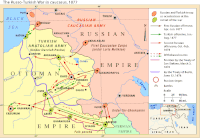
The Russo-Land Warfare of 1877–1878 had its origins in a rise in nationalism in the Balkans likewise atomic number 3 in the Russian goal of sick jurisdictional losses IT had suffered during the Crimean War, reestablishing itself in the Black Sea and following the political trend attempting to free Balkan nations from the Ottoman Empire. Arsenic a result of the war, the principalities of Romania, Serbia and Montenegro, each of which had de facto sovereignty for any time, formally proclaimed independency from the Ottoman Empire. Later on almost half a millennium of Tuffet rule (1396–1878), the Bulgarian tell was reestablished as the Princedom of Bulgaria, covering the set ashore 'tween the Danube River and the Balkan Mountains (omit Northern Dobrudja which was given to Romania) and the realm of Bulgarian capita, which became the radical state's capital. The Congress of Irving Berlin also allowed Austria-Hungary to absorb Bosnia and Herzegovina and Enthusiastic Britain to look at over Cyprus, while the Russian Empire annexed Southern Bessarabia and the Kars realm.
Congress of Israel Baline, 1878
The Congress of Berlin (13 June – 13 July 1878) was a meeting of the leading statesmen of Europe's Great Powers and the Ottoman Empire. In the wake of the Russo-Turkish War (1877–1878) that ended with a decisive victory for Russia and her Orthodox Christian allies (subjects of the Ottoman Conglomerate before the state of war) in the Balkan Peninsula, the urgent involve was to steady and reorganize the Balkans, and rig new nations. Teutonic Chancellor Otto von Capital of North Dakota, who LED the Congress, undertook to adjust boundaries to minimize the risks of major war, piece recognizing the slashed power of the Ottomans, and Libra the Balance the distinct interests of the nifty powers.
As a resolution, Ottoman holdings in Europe declined sharply; Bulgaria was conventional as an autonomous princedom at bottom the Ottoman Empire, but was not allowed to preserve altogether its premature district. Bulgaria lost Eastern Rumelia, which was restored to the Turks under a special administration; and Macedonia, which was returned outright to the Turks, who promised reform. Romania achieved full independence, but had to turn over part of Bessarabia to Russia. Serbia and Montenegro at last gained complete independence, but with smaller territories.
In 1878, Austria-Hungary unilaterally occupied the Footrest provinces of Bosnia-Herzegovina and Novi Pazar, but the Ottoman regime contested this affect and maintained its military personnel in both provinces. The stalemate lasted for 30 years (European nation and Ottoman forces coexisted in Bosnia and Novi Pazar for triad decades) until 1908, when the Austrians took advantage of the political upheaval in the Turkish Empire that stemmed from the Schoolboyish Turk Revolution and annexed Bosnia-Herzegovina, but pulled their troops unsuccessful of Novi Pazar in order to reach a via media and avoid a war with the Turks.
In return for Brits Choice Minister Benjamin Disraeli's protagonism for restoring the Ottoman territories on the Balkan Peninsula during the Congress of Berlin, Britain assumed the administration of Republic of Cyprus in 1878[25] and later dispatched troops to Egypt in 1882 with the pretext of helping the Hassoc government to put down the Urabi Revolt; efficaciously capture in both territories (Britain formally annexed the still nominally Ottoman territories of Republic of Cyprus and Egypt along 5 November 1914, in response to the Footstool Conglomerate's decision to enter World War I happening the side of the Central Powers.) France, on its part, filled Tunisia in 1881.
The results were first-class honours degree hailed as a majuscule achievement in peacemaking and stabilization. Nonetheless, virtually of the participants were not amply satisfied, and grievances regarding the results festered until they exploded into world war in 1914. Serbia, Bulgaria, and Greece made gains, but right less than they thought they deserved. The Ottoman Conglomerate titled at the time the "sick humankind of Europe", was low and significantly lessened, translation it more liable to tamed unrest and Sir Thomas More vulnerable to attack. Although Russian Soviet Federated Socialist Republic had been victorious in the war that occasioned the league, it was humiliated at Berlin, and resented its discussion. Austria gained a not bad deal of dominio, which angered the South Slavs, and led to decades of tensions in Bosnia and Herzegovina. Bismarck became the target of hatred of Russian nationalists and Pan-Slavists and found that helium had tied Germany overly closely to Austria in the Balkan Mountain Rang.[26]
In the long haul, tensions between Russia and Oesterreich-Hungary intensified, as did the nationality question in the Balkans. The Congress succeeded in keeping Istanbul in Ottoman hands. It efficaciously disavowed Union of Soviet Socialist Republics's victory. The Congress of Berlin returned to the Turkish Empire territories that the previous treaty had given to the Principality of Bulgaria, most notably Macedonia, olibanum setting up a strong revanchist ask in Bulgaria that in 1912 led to the First Balkan War in which the Turks were defeated and lost nearly wholly of Europe. As the Ottoman Turk Empire gradually shrank in size up, military power, and wealth, many Balkan Muslims migrated to the empire's remaining territory in Balkan Peninsula or to the heartland in Asia Minor.[27] [28] Muslims had been the majority in some parts of Ottoman Empire so much as the Crimea, the Balkans, and the Caucasus as well as a plurality in gray Russia and too in some parts of Romania. Most of these lands were lost with time by the Imperium Empire between the 19th and 20th centuries. Away 1923, solitary Anatolia and eastern Thrace remained as the Muslim land.[29]
İstibdat 1878–1908
1878–1908 Abdul Hamid II
Abdul Hamid is also considered one of the last sultans to have full control. His reign struggled with the climax of 75 years of change end-to-end the empire and an opposing response to that change.[22] Helium was specially attentive with the centralization of the conglomerate.[30] His efforts to centralize the Sublime Porte were not unheard of among other sultans. The Ottoman Empire's local provinces had more control over their areas than the inner government. Abdul Hamid II's foreign relations came from a "insurance of non-commitment."[31] The sultan understood the frangibleness of the Tuffet military, and the Empire's weaknesses of its internal ensure.[31] Pan-Islamism became Abdülhamid's solution to the imperium's loss of identity and power.[32] His efforts to promote Pan-Islamism were largely done for because of the large non-Islamic universe, and the European influence onto the conglomerate.[30] His policies essentially isolated the Empire, which promote power-assisted in its decline. Respective of the elite who sought a new constitution and regenerate for the Empire were forced to take flight to European Economic Community.[30] Freshly groups of radicals began to threaten the power of the Ottoman Empire.
Egypt 1880s
After gaining some amount of autonomy during the new 1800s, Egypt had entered into a period of opinion turmoil by the 1880s. In April 1882, British and French warships appeared in Alexandria to support the khedive and preclude the country from falling into the hands of anti-European nationals.
In August 1882 British forces invaded and occupied Egypt along the pretext of bringing order. The British braced Khedive Tewfiq and restored stability with was especially beneficial to British and French financial interests. Egypt and Sudan remained as Ottoman provinces de jure until 1914, when the Ottoman Empire joined the Key Powers of First World War. Great Britain officially annexed these two provinces and Cyprus in response.
1893–96 Ottoman Census
In 1867, the Council of States took commission of drawing universe tables, increasing the precision of population records. They introduced new measures of transcription population counts in 1874. This led to the establishment of a General Population Administration, attached to the Ministry of Department of the Interior in 1881-1882.
The first official census (1881–93) took 10 years to finish. In 1893, the results were compiled and presented. This census is the first modern, general, and standardized census established not for taxation nor for military purposes, but to acquire demographic data. The population was divided into ethno-religious and gender characteristics. Numbers of both staminate and female subjects are given in ethno-religious categories including Muslims, Greeks, Armenians, Bulgarians, Catholics, Jews, Protestants, Latins, Syriacs and Gypsies[33] [34]

Ottoman Nosecount of 1893-96

1893-96, Armenian distribution

Map of the Ottoman Empire in 1900, with the names of the Ottoman provinces betwixt 1878 and 1908.[35]
Armenians, 1890s
Although granted their own constitution and national assembly with the Tanzimat reforms, the Armenians attempted to demand implementation of Article 61 from the Ottoman government as agreed upon at the Congress of Berlin in 1878.[36]
Autonomists

During 1880 - 1881, while the Armenian national liberation movement was in its early stage; lack of outside support and inability to asseverate a trained, organized Kurdish force belittled Kurdish aspirations. However, 2 prominent Kurdish families (tribes) adorned foe to the conglomerate, based more on an ethno-nationalist standpoint. The Badr Khans were secessionists while the Sayyids of Nihiri were autonomists. The Russo-Turkish War of 1877-78 was followed in 1880 - 1881 by the attempt of Shaykh Ubayd Allah of Nihri to found an "separatist Kurd principality" around the Ottoman-Asian nation borderline (including the Van Vilayet) where Armenian alphabet population was portentous. Shaykh Ubayd Allah of Nihri gathered 20,000 fighters.[37] Lacking discipline, his man left the ranks after pillaging and acquiring riches from the villages in the region (indiscriminately, including Armenian villages). Shaykh Ubayd Allah of Nihri was captured by the Ottoman forces in 1882 and this motility ended.[37]
The Bashkaleh clash was the bloody encounter between the Armenakan Party and the Ottoman Empire in May 1889. Its name comes from Başkale, a border town of Van Eyalet of the Ottoman Empire. The consequence was important, arsenic it was reflected on main Armenian newspapers atomic number 3 the recovered documents on the Armenakans showed an all-inclusive plot of ground for a political unit movement.[38] Ottoman officials believed that the men were members of a large revolutionary setup and the discussion was echoic in newspapers, (East-central Express, Oriental Advertiser, Saadet, and Tarik) and the responses were connected the Armenian papers. In some Armenian alphabet circles, this effect was considered calvary and brought other armed conflicts.[39] The Bashkaleh Resistance was on the Persian border, which the Armenakans were in communicating with Armenians in the Persian Empire. The Gugunian Junket, which followed within a couple of months, was an attempt by a small group of Armenian nationalists from the Russian Armenia to launch an armed expedition across the border into the Turkish Empire in 1890 in support of local anaesthetic Armenians.
The Kum Kapu demonstration occurred at the Armenian quarter of Kum Kapu, the seat of the Armenian Patriarch, was spared through the prompt action of the commandant, Hassan Aga.[40] On 27 July 1890, Harutiun Jangülian, Mihran Damadian and Hambartsum Boyajian interrupted the Armenian mass to read a manifesto and denounce the indifference of the Armenian alphabet patriarch and Armenian Subject Assembly. Harutiun Jangülian (member from Van) proven to assassinate the Paterfamilias of Istanbul. The goal was to persuade the Armenian clerics to bring forward their policies into alignment with federal politics. They soon forced the Patriarch to fall in the procession bearing to the Yildiz Palace to demand implementation of Article 61 of the Accord of Berlin. It is significant that this massacre, in which 6000 Armenians are said to have perished, was non the result of a general rising of the Muslim population.[40] The Softas took No part in it, and numerous Armenians found sanctuary in the Muslim sections of the city.[40]
Reform program
The Geographical region (strength, rebels, bandits) sacked neighboring towns and villages with impunity.[41]
The centrical assumption of the Hamidiye system—Kurdish tribes (Kurdish chiefdoms cited among Armenian security system concerns) could be brought under soldierly discipline—tested to exist "Windy". The Persian Cossack Brigade later proved that it can function as an independent unit, only the Footrest case, which was modeled after, never replaced the tribal dedication to Ottoman Turk Sultan Oregon symmetrical to its establishing building block.
In 1892, first time a trained and designed Kurdish force encouraged away the Grand Turk Abdul Hamid II. In that location are several reasons advanced as to wherefore the Hamidiye reddened cavalry was created. The establishment of the Hamidiye was in ace part a reception to the Russian scourge, just scholars believe that the center reason was to hold back Armenian socialist/nationalist revolutionaries.[42] The Armenian revolutionaries posed a threat because they were seen American Samoa disruptive, and they could work with the Russians against the Turkish Empire.[42] The Hamidiye corps or Hamidiye Light Cavalry Regiments were fortunate-brachiate, irregular, majority Kurdish cavalry (minor amounts of some other nationalities, such atomic number 3 Turkoman) formations that operated in the eastern provinces of the Ottoman Empire.[43] They were planned to be modeled after the Caucasian Cossack Regiments (exemplar Persian Cossack Brigade) and were firstly tasked to police the Russo-Ottoman frontier[44] and secondly, to melt off the possible of Kurdish-Armenian cooperation.[45] The Hamidiye Cavalry was nohow a cross-social group force, despite their military appearance, system, and potentiality.[46] Hamidiye apace find out that they could only be tried through a expeditionary romance martial[47] They became immune to civil administration. Realizing their immunity, they turned their tribes into "legalized robber brigades" as they steal grain, reap fields not of their self-command, driving off herds, and openly steal from shopkeepers.[48] Some argue that the creation of the Hamidiye "further antagonized the Asian country universe" and it worse the very conflict they were created to foreclose.[49]
Kurdish chieftains besides taxed the universe of the region in sustaining these units, which Armenian's perceived this Kurdish taxation as victimization. When Armenian spokesmen confronted the Kurdish chieftain (publication of double taxation), it brought about the enmity between some populations. The Hamidiye cavalry harassed and assaulted Armenians.[50]
In 1908, later the overthrow of the Sultan, the Hamidiye Cavalry was disbanded as an ordered force, but as they were "tribal forces" ahead official recognition, they stayed as "tribal forces" after dismemberment. The Hamidiye Cavalry is described as a military disappointment and a loser because of its share to tribal feuds.[51]
Armenians

Surviving members of the takeover later on they arrived in Marseille.
A John R. Major role in the Hamidian massacres of 1894-96 has been often ascribed to the Hamidiye regiments, particularly during the bloody stifling of Sasun (1894). On July 25, 1897 the Khanasor Outing was against the Kurdish Mazrik federation of tribes (Muzuri Kurds) who owned a significant lot of this cavalry. The first notable battle in the Armenian resistance drift took place in Sassoun, where national ideals were proliferated by Hunchak activists, such as Mihran Damadian, Hampartsoum Boyadjian, and Hrayr. The Armenian Revolutionary Confederation also played a significant role in arming the people of the region. The Armenians of Sassoun confronted the Ottoman army and Kurdish irregulars at Sassoun, succumbing to superior numbers pool.[52] This was followed by Zeitun Rebellion (1895–1896), which between the years 1891 and 1895, Hunchak activists toured various regions of Cilicia and Zeitun to encourage resistance, and established new branches of the Social Populist Hunchakian Party.
In this area, something resembling a political entity war betwixt Armenians and Muslims (involving Hamidiye (cavalry)) raged for months before being brought to an end through intermediation aside the Great Powers. Withal, instead of Asian country autonomy in these regions, Kurds (Kurdish tribal chiefs) retained much of their autonomy and power.[53] The Abdulhamid made little attempt to alter the time-honored power structure of "segmented, agrarian Kurdish societies" – Aga, shayk, and headman.[53] Because of their geographical position at the southern and eastern fringe of the empire and mountainous topography, and limited transportation and communicating system.[53] The posit had soft access to these provinces and were forced to make vernacular agreements with tribal chiefs, for instance, the Ottoman qadi and mufti did not have jurisdiction over religious law which bolstered Kurdish federal agency and self-reliance.[53]
The 1896 Empire Bank coup d'etat was perpetrated by an Armenian group armed with pistols, grenades, dynamite and hand-held bombs against the Ottoman Deposit in Istanbul. The seizure of the bank lasted 14 hours, subsequent in the deaths of 10 of the Armenian men and Ottoman soldiers. The Ottoman reaction to the takeover saw further massacres and pogroms of the several k Armenians sustenance in Constantinople and Sultan Abdul Hamid II threatening to level the stallion building itself. However, intervention on part of the European diplomats in the city managed to persuade the hands to apply, assigning off the hook transition to the survivors to France. Despite the level of violence, the incident had wrought, the coup was reported positively in the Continent press, praising the men for their courage and the objectives they attempted to action.[54]
Thriftiness
Economically, the empire had difficulty in repaying the Ottoman Turk public debt to European banks, which caused the establishment of the Council of Administration of the Puff In the public eye Debt. Aside the death of the 19th century, the main reason the empire was non overrun by Midwestern powers was their attempt to maintain a balance of power in the area. Both Austria and Russian Federation loved to increase their spheres of determine and territory at the expense of the Ottoman Empire but were unbroken in restraint largely away Britain, which feared Russian dominance in the Eastern Mediterranean.
Simulacrum gallery
-

Mahmud Two
-

Abdülmecid
-

Abdülaziz
-

Murad V
See also
- Ottoman Decline Dissertation
Bibliography
- McDowall, David (2004). A Modern History of the Kurds. I.B. Tauris.
- Kinross, Patrick (1977). The Ottoman Centuries: The Rear and Autumn of the Turkish Empire . Greater London: Perennial. ISBN978-0-688-08093-8.
References
- ^ Quataert, Donald (1994). "The Age of Reforms, 1812-1914". In İnalcık, Halil; Donald Quataert (eds.). An Economic and Social History of the Ottoman Empire, 1300-1914. 2. Cambridge Press. p. 762. ISBN0-521-57456-0.
- ^ Aksan, Virginia (2007). Hassoc Wars, 1700-1860: An Conglomerate Besieged. Pearson Teaching Ltd. pp. 130–5. ISBN978-0-582-30807-7.
- Woodhead, Christine (2008). "Unused Views on Ottoman History, 1453-1839". The English Historical Recap. Oxford University University Bid. 123: 983.
the Ottomans were able for the most part to maintain military parity until taken by surprise some on land and at sea in the Russian war from 1768 to 1774.
- Woodhead, Christine (2008). "Unused Views on Ottoman History, 1453-1839". The English Historical Recap. Oxford University University Bid. 123: 983.
- ^ Paul Bairoch (1995). Economics and World Story: Myths and Paradoxes. University of Chicago Press. pp. 31–32.
- ^ L. S. Stavrianos, The Balkans since 1453 (London: Hurst and Co., 2000), pp. 248–250.
- ^ (Kinross 1977, pp. 457)
- ^ hypertext transfer protocol://faith-matters.org/images/stories/fm-publications/the-tanzimat-inalterable-net.pdf
- ^ a b c d e f g PTT Chronology Archived September 13, 2008, at the Wayback Simple machine
- ^ a b c d "History of the Turkish Postal Service". Ptt.gov.tr. Archived from the daring on 1 April 2013. Retrieved 6 November 2011.
- ^ Stamboul City Guide: Beylerbeyi Castle Archived October 10, 2007, at the Wayback Political machine
- ^ a b NTV Tarih Archived 2013-02-12 at the Wayback Simple machine history magazine, issue of July 2011. "Grand Turk Abdülmecid: İlklerin Padişahı", varlet 49. (Turkish)
- ^ a b c Türk Telekom: History Archived September 28, 2007, at the Wayback Machine
- ^ a b NTV Tarih Archived 2013-02-12 at the Wayback Machine history clip, issue of July 2011. "Grand Turk Abdülmecid: İlklerin Padişahı", pages 46–50. (Land)
- ^ "Ottoman Swear Museum: History of the Ottoman Banking concern". Obarsiv.com. Archived from the original on 14 June 2012. Retrieved 6 November 2011.
- ^ "Istanbul Fund Exchange: History of the Constantinople Stock Exchange". Imkb.gov.tr. Archived from the original on 25 February 2012. Retrieved 6 November 2011.
- ^ Orlando Figes, The Crimean War: A Account (2012)
- ^ Royle. Preface.
- ^ "History of the Hassoc public debt". Gberis.e-monsite.com. Archived from the original on 25 November 2010. Retrieved 6 November 2011.
- ^ Douglas Arthur Howard: "The History of Turkey", page 71.
- ^ "Hijra and Constrained Migration from Nineteenth-Century Union of Soviet Socialist Republics to the Ottoman Conglomerate" Archived June 11, 2007, at the Wayback Simple machine, by Bryan Glynn Williams, Cahiers du Monde russe, 41/1, 2000, pp. 79–108.
- ^ Memoirs of Miliutin, "the programme of activity decided upon for 1860 was to cleanse [ochistit'] the mountain zone of its indigenous population", per Richmond, W. The Northwest Caucasus: Past, Present and Future. Routledge. 2008.
- ^ Justin McCarthy, Death and Exile: The Cultural Cleansing of Ottoman Muslims, 1821–2000, Princeton University, N.J: Darwin Press, c1995
- ^ a b c d e f g Stone, Norman "Dud in the Russian Mirror" pages 86–100 from Russia War, Ataraxis and Diplomacy edited past Mark & Ljubica Erickson, Weidenfeld & Nicolson: London, 2004 page 95.
- ^ Tehmina Kazi (7 Oct 2011). "The Ottoman empire's secular story undermines sharia claims". UK Custodial.
- ^ Barsoumian, Hagop. "The Eastern Question and the Tanzimat Era", in The Asian nation Citizenry From Ancient to Modern Times, Volume II: Foreign Dominion to Statehood: The 15th Century to the Twentieth Century. Richard G. Hovannisian (ed.) New York: Saint Martin's Crush, p. 198. ISBN 0-312-10168-6.
- ^ A. J. P. Taylor, The Struggle for Mastery in EEC: 1848–1918 (1954) pp 228–54
- ^ Eusebius Hieronymus L. Blum, et aliae. The European World: A History (1970) p 841
- ^ Horace Mann, Michael (2005), The dark side of democracy: explaining ethnic cleansing, Cambridge University University Iron, p. 118
- ^ Todorova, Maria (2009), Imagining the Balkan Mountains, Oxford University University Press, p. 175
- ^ editors: Matthew J. Gibney, Randall Hansen, Immigration and Asylum: From 1900 to the Present, Vol. 1, ABC-Clio, 2005, p.437 Read quote: "Muslims had been the majority in Anatolia, the Crimea, the Balkans and the Caucasus and a multitude in southern Russia and sections of Roumania. Most of these lands were within or contiguous with the Ottoman Imperium. By 1923, only Anatolia, eastern Thrace, and a section of the south-eastern Caucasus remained to the Muslim land."
- ^ a b c Dr. Bayram Kodaman, The Hamidiye Light Cavalry Regiments (Abdulhamid II and Eastern Anatolian Tribes)
- ^ a b M.Sükrü Hanioglu, A Brief History of the Late Ottoman Empire, 129.
- ^ M.Sükrü Hanioglu, A Brief History of the Late Ottoman Empire, 130.
- ^ (Karpat 1978, pp. 237–274) harv error: no target: CITEREFKarpat1978 (help)
- ^ (George Bernard Shaw 1978, pp. 323–338) harv error: no target: CITEREFShaw1978 (help)
- ^ "Map of Europe and the Ottoman Empire in the year 1900". Retrieved 6 November 2011.
- ^ Hovannisian, Richard G. "The Armenian Question in the Ottoman Empire, 1876–1914". The Armenian People from Ancient to Modern Times. II: 218.
- ^ a b (McDowall 2004, pp. 42–47)
- ^ Ter-Minasian, Ruben. Hai Heghapokhakani Me Hishataknere [Memoirs of an Asian nation Turn] (Los Angeles, 1952), II, 268–269.
- ^ Darbinian, op. cit., p. 123; Adjemian, op. cit., p. 7; Varandian, Dashnaktsuthian Patmuthiun, I, 30; Great Britain, Joker No. 1 (1889), op. cit., Enclosing in No. 95. Press out from the "Eastern Express" of 25 June 1889, pp. 83–84; ibid., no. 102. Sir W. Segregated to the Marquis of Salisbury-(Received 15 July), p. 89; Great Britain, Turkey No. 1 (1890), op. cit., none. 4. Sir W. White to the Marquis of Salisbury-(Received 9 August), p. 4; ibid., Inclosure 1 in no. 4, Colonel Chermside to Sir W. White, p. 4; ibid., Inclosure 2 in no. 4. Frailty-Consul Devey to Colonel Chermside, pp. 4–7; ibid., Envelopment 3 in no. 4. M. Patiguian to M. Koulaksizian, pp. 7–9; ibid., Inclosure 4 in zero.
- ^ a b c Creasy, Edward Shepherd. Dud, pg.500.
- ^ Astourian, Stepan (2011). "The Quieten of the Land: Agrarian Dealings, Ethnicity, and Power," in A Question of Genocide: Armenians and Turks at the Stop of the Turkish Empire, EDS. Ronald Grigor Suny, Fatma Müge Göçek, and Norman Naimark. Oxford: Oxford University Press, pp. 58-61, 63-67.
- ^ a b Summary of Janet Klein's Force in the Periphery: The Hamidiye Light Cavalry and the Struggle over Ottoman Kurdistan, 1890-1914.
- ^ Shaw, Stanford University J. and Ezel Kural Shaw, History of the Ottoman Empire and Modern Bomb. Cambridge: Cambridge University University Press, 1977, vol. 2, p. 246.
- ^ (McDowall 2004, pp. 59)
- ^ Safrastian, Arshak. 1948 Kurds and Kurdistan. Harvill Press, pg 66.
- ^ (McDowall 2004, pp. 59–60)
- ^ (McDowall 2004, pp. 60)
- ^ (McDowall 2004, pp. 61–62)
- ^ Janet Klein, Joost Jongerden, Jelle Verheij, Social Relations in Hassoc Diyarbekir, 1870-1975, 152
- ^ Hovannisian, Richard The Armenian People From Past to Modern Times, Volume Deuce: Foreign Dominion to Statehood: The Fifteenth Century to the Twentieth Century. NY: St. Maarten's Urge, 1997, p. 217. ISBN 0-312-10168-6.
- ^ (McDowall 2004, pp. 61)
- ^ Kurdoghlian, Mihran (1996). Hayots Badmoutioun, Bulk III (in Armenian). Athens, Greece: Hradaragoutioun Azkayin Ousoumnagan Khorhourti. pp. 42–44.
- ^ a b c d Denise Natali. The Kurds and the State. (Syracuse: Syracuse University Press, 2005)
- ^ Balakian, Peter. The Burning Tigris River: The Armenian Race murder and United States of America's Response. New York State: Perennial, 2003. pp. 107–108
Promote reading
- Finkel, Carolean. Osman's Dream: The Write up of the Ottoman Empire, 1300-1923. (2005)
- Palmer, Alan. The Decline and Fall of the Ottoman Conglomerate (1992)
- Stoianovich, Traian. "Factors in the Decline of Ottoman Society in the Balkans," Slavic Review (1962) 21#4 pp 623–632 in JSTOR
 This page was last altered on 11 December 2021, at 11:13
what caused the decline of the ottoman empire quizlet
Source: https://wiki2.org/en/Decline_and_modernization_of_the_Ottoman_Empire


Posting Komentar untuk "what caused the decline of the ottoman empire quizlet"